Be yourself; Everyone else is already taken.
— Oscar Wilde.
This is the first post on my new blog. I’m just getting this new blog going, so stay tuned for more. Subscribe below to get notified when I post new updates.
Be yourself; Everyone else is already taken.
— Oscar Wilde.
This is the first post on my new blog. I’m just getting this new blog going, so stay tuned for more. Subscribe below to get notified when I post new updates.
The future of journalism is very bright, and will be very fascinating. As BBC said in our class materials, traditional news is dead. I believe that this is only partly true. While multi-media and interactive news is important for the future of the media, there is still something to be said for a concise explanation and a few pictures in a news article.
In the source I examined, Firestone, by the Guardian, the authors use a multi-media article to discuss a bushfire. I think that it was a very interesting way to display news, with scrolling and viewing information in chapters with moving pictures and videos. Each small section of text is accompanied by a different picture, moving animation or map, helping to visually aid the information the author is trying to get across to us. This is a very important part of the future of social media, as the attention span of the public is only going to further decrease as technology consumes more and more of our time. I personally am still a fan of the traditional news article, and although this multi-media was very cool it feels like more work than I want to put in to see the information. It felt like I had to put in effort to see more of the article, which made me less interested in reading what it had to say.
This type of media feels like an attempt to begin to create ‘news reporting from the future,’ but the more I think about it, the less and less I hope news starts to be covered this way. I am a huge advocate of the concise news article, and I am really hoping that the media is continuing to be covered in that way. I enjoy being able to read a short excerpt and be able to understand everything that I came for, rather than having to search through pictures and videos and other chapters to find the information.
I do think that participatory media coverage is a great idea, and will help people to be more interested in the contents that they are reading. While this is true, I also think that it needs to be implemented with caution, and not overdone. Articles like this one by the Guardian have tried to do too much, causing readers to get lost in all of the different sources and information being thrown at them all at once. It was very interesting at first glance, but then I forgot some of the earlier information after scrolling through different chapters and watching videos and images.
Clearly this technology is far from perfected, but I do not think that they should transition to multi media news alone. I think that in an optimal setting, they will be able to merge this type of multi media news, while still keeping a clear and concise message, allowing people to still get the information they came for, and not get lost in the stuff they dont need.
Thank you for the great class! Auston
Select
Jon Henley-Laurence Topham-Guardian team-Mustafa Khalili-Francesca Panetta – https://www.theguardian.com/world/interactive/2013/may/26/firestorm-bushfire-dunalley-holmes-family
Social media dominates today’s society. Many are highly motivated to act and live accordingly to social media, as we learned in the section about social media and internet influencers. These new influencers are the people who run all of popular culture, and it will only continue to get worse and worse as the younger generations also become addicted to their technology just like our generation has.
Social media, and the internet as a whole is currently at its all time high of popularity. According to Forbes, however, this popularity is only going to further increase as the internet evolves more and more.

The article believes that in the future, the internet and social media will have a lot more to do with virtual and augmented reality, making the experience of influencers all that more important. Additionally, Forbes believes that the world will have generated an improved and permanent internet connection, allowing more wide availability of the internet and social media to those who desire to take part in it.
Another thing to consider about social media is its target market. Apps like Instagram and Tik Tok are extremely tailored to the younger crowd that primarily use them, however in the coming years this is likely to change. I come from a generation that is extremely dependent on technology and the internet as a whole, and I suspect that my generation will not ween from this tendency as we grow older.

As these apps realize my aging generation is still interested, they will have to evolve to accommodate multiple target crowds. Assuming every younger generation is just as infatuated with social media as my own, apps like Instagram will now have to have content for older people, middle aged and young kids. This is a phenomenon that we have never seen on the internet, as it has stereotypically been used only by a younger crowd in today’s age.
This article further states that privacy will be commoditized. In an era where privacy rights and internet security are already relatively a concern, these issues are only going to get worse, with more and more privacy sworn away through unread terms and conditions. Especially as uninformed users continue to flock to new technology, Forbes believes that only the rich will have the resources and technology to keep themselves truly protected from cyber issues. This will open up many opportunities for new firms and companies to create business to keep people safe online and on social media, and will create a heightened sense of importance for cyber security even more so than it is in today’s age.
Lastly, I wanted to write a quick goodbye to everyone in the class. It has been a great semester, and I have had a lot of fun learning about social media in a critical sense that I had never previously considered. Thank you so much for all of the cool stuff you taught me this semester, and I will miss you all! I wish you all the best.
DeMers, Jayson. “7 Predictions For How The Internet Will Change Over The Next 15 Years.” Forbes. Forbes Magazine, April 18, 2016. https://www.forbes.com/sites/jaysondemers/2016/04/18/7-predictions-for-how-the-internet-will-change-over-the-next-15-years/#5da0350622e0.
Big Data seems to be a very hot topic around society in today’s date. However, even with all of the talk surrounding this topic, it seems as though there are many misconceptions surrounding this topic. Big Data used to be talking about data sets that were too large or complex to be sorted through with standard processing hardware, and previously had to be dealt with exclusively via a super computer. This is no longer the case however, as a Routledge article by Boyd and Crawford suggests that these large quantities of data are now able to be analyzed via any regular desktop with enough processing power. That being said, we have opened up a whole can of worms about the availability and accessibility of our data online.
With all of the information that we are putting out online, these data mining and processing companies really have gotten to know us well. With all of our data readily available to big companies online, we have hit a major crossroads in our society. As we move forward, large corporations such as Oracle and many others have the power to use our data for our benefit, or purely for profit. They are able to use this data to improve our virtual experience, or benefit themselves. They have the power to make the internet a more user friendly place where the experience is tailored to the individual, but also have the capabilities to use this power to their own corporate benefit.

Doing some more research on Oracle following these questions, I have discovered that they have a whole page on their website dedicated to their policy of big data and their mission as a company to use it. Oracle states that big data can be use widely in a predictive sense for corporations, allowing them to stay ahead of the curve of the competition. By being able to track consumer trends and spending habits, they are able to know what you want, and how you want it, before you are even aware. While this is being used in majority to help the corporations, it actually is mutually beneficial, as the individual has wide access and availability to the goods and services they desire, as they want them. Companies such as oracle have streamlined the supply and demand process, leaving the only question remaining of whether or not it is ethical?
Personally speaking, I think it is great what they are doing, and strongly am in favor that this continues. As someone from the perspective of, “I have nothing to hide,” I think that it is great that businesses are able to better prepare to accommodate for the things that I want and will eventually need. I understand the argument that this data is my private business and companies should not be able to buy and sell the rights to the knowledge of my data and spending, but on the other hand it does not negatively affect me enough to the point that I am bothered by it.
Casteel, Heather, and Eytan Adar. “CRITICAL QUESTIONS FOR BIG DATA.” Taylor & Francis. Accessed April 3, 2020. https://www.tandfonline.com/doi/abs/10.1080/1369118X.2012.678878.
“Oracle Big Data.” Oracle. Accessed April 3, 2020. https://www.oracle.com/big-data/guide/big-data-use-cases.html.
Peace journalism is a type of journalism that could be used very strategically with my generation. Growing up in the 2000s, I was often exposed to a level of anti-muslim attitude following the attacks of September 11. These attitudes were based off of the attacks themselves, but even more so due to the violent media and the targeting of the muslim people as a whole. I was able to see how they as a people were generalized as one, and how that fosters a negative stereotype and unjust racism towards a group of people who, as a whole, did not deserve it.

While doing research on this topic, I came across a very interesting article written by the University of Michigan surrounding the topic of the public view of Muslims following 9/11. The article spoke about the fact that the United States public became very afraid of the Muslim Americans, actually doing just the opposite of what they were trying to do by targeting them in their media. The article states that by being afraid of the Muslims in the media, and portraying them in a negative light, they were actually self sabotaging themselves, by furthering the divide between the US and the governments of the countries from which these American citizens are from.
That is a very interesting point that I had not yet considered when talking about this topic. When thinking about the media in response to the 9/11 attacks, it felt as though all of the correspondence was from a place of fear or retaliation. Looking back however, many of the problems we have had in the world since then could have been resolved had we taken Johan Galtung’s ‘Peace Journalism’ approach.

Galtung’s ‘Peace Journalism’ is a concept which aims to take reporting of conflicts or dualistic in nature to a proactive and humanizing nature. It’s goal is to humanize the ‘enemy’ such as the Muslim people in the example of September 11th, and gives a voice to the less heard. It would have been able to prevent a lot of unnecessary hostility between the American public and some of its Muslim citizens. The violence reporting that was used in response to these attacks is something that has set back multiple generations into Islamophobia and has permanently altered the world view of my generation and Gen Z.
A Huffington Post article speaks on the ways that the United States can get over their fear of the Islam community, regardless of their faith. Some of those ways are to make friends with the Islam community and to speak openly about religion, especially with them. The common point that has shown up here, yet again, is to call out bias and racism displayed in our news networks. The war journalism is the root of this discrimination and is very easily fixed with more careful wording and portrayal of the Muslim community. I think that we would all be pleasantly surprised by the change we would see if Galtung’s Peace Journalism were adopted in this case.
Gillum, Rachel M. “Muslims in a Post-9/11 America.” University of Michigan Press. Accessed April 3, 2020. https://www.press.umich.edu/9765804/muslims_in_a_post_9_11_america.
Russo, Carla Herreria. “How To Fight Islamophobia In America, No Matter Your Faith.” HuffPost. HuffPost, March 19, 2019. https://www.huffpost.com/entry/how-to-fight-islamophobia_n_5c8c1d81e4b0d7f6b0f37515.
COVID-19 has been the epicenter of world news, and especially has been the exclusive coverage of Europe over the recent weeks. The world understands Spain and Italy to be two of the hardest hit countries by this virus, and its effects have been seen on international media platforms. It has been covered by every popular media in the EU, especially those in Spain during my time in Barcelona.
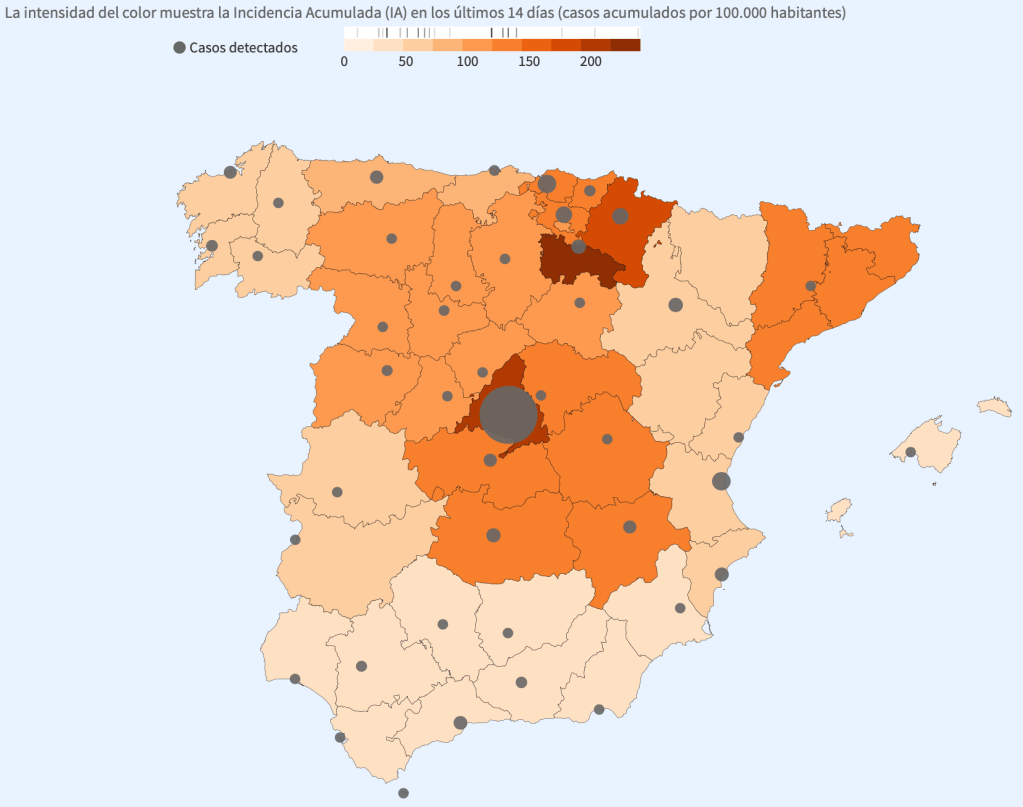
People would often check maps like this one, updated regularly with the number of cases, and where they were. Sources like RTVE provide these maps with logistic information and facts, not as much stories. It is regularly updated and provides the numbers, and any adjustment on the CDC travel advisory. This is a great source to use when looking for the quick information without needing the full story. I personally found this the most effective form of information, since these figures were the parameters being examined pending the decision of the United States whether or not to send their students home.
If I was looking for more information about the world as a whole, or the severity of the virus relative to each other, I would often use sources such as BBC. I found that BBC often talked about different areas of the world comparatively, such as their most recent coverage that stated that Spain’s death toll had now surpassed China. This is absolutely shocking to see, as China had been previously viewed as the epicenter of the issue, but BBC and other world news broadcasters have shown the dissemination and major issue of the virus, especially in the US, Italy and Spain. They would not include as much visual content as the other sources I viewed, but did include multiple pictures about mobile testing sites.
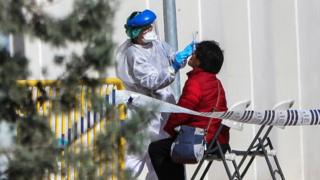
BBC also provides more of a global context than other sources in terms of story telling, speaking of notable individuals from the target countries who have contracted the disease, or even some governmental responses to the virus in hopes to flatten the curve. They also included pictures from other areas of Europe, such as Zurich and Germany, whereas other sources stuck strictly to photos of the Spanish crisis.
Sources such as the Washington Post aim to show the effects of the disease, rather than purely factual data. The link above comes from a video in a Washington Post article that shows an olympic ice rink in Madrid having been turned into a temporary morgue due to the massive jump in the death total that Spain has faced in the past few days. Articles like this one often highlight the personal impact of the disease, and the turmoil it has ridden on the country as a whole.

This picture from the Washington Post article shows a makeshift hospital in Montjuic. This is a prime example of the Spanish government rationing their supplies and making an effort to take care of all that they can. This is also, however, a visual example of the crisis that they are facing when deciding who should receive their health care and health resources. They also directly quote in their articles, something that many other sources I examined did not. “There are some hospitals which have already collapsed,” said Oriol Mitjà, an infectious disease specialist at Germans Trias i Pujol Hospital in Barcelona. “They have to make a decision when to admit a patient to intensive care or not, and the criteria is mainly by age, so some elderly people are not prioritized.” This goes to show how hard their health care system has been hit by this virus, and they are now having to make the difficult decisions of who deserves the resources more, and who unfortunately will die from the lack of health care.
Overall, I believe that Spain and the world does a good job with portraying the COVID-19 crisis in a visually engaging way. They accomplish this by posting awe-striking imagery such as temporary hospitals or makeshift morgues, things that cannot be adequately described only in words. This is a field that will continue to be instrumental to the coverage of this virus, and will continue to be the leading cause of why I will do my part in the self isolation.
RTVE.es. “Coronavirus – El Mapa Del Coronavirus En España: 3.445 Muertos y Más De 47.600 Casos.” RTVE.es, March 25, 2020. https://www.rtve.es/noticias/20200325/mapa-del-coronavirus-espana/2004681.shtml.
“Coronavirus: Spain’s Death Toll Surpasses China’s.” BBC News. BBC, March 25, 2020. https://www.bbc.com/news/world-europe-52036836.
Pamela Rolfe, Loveday Morris. “Spain’s Count of Coronavirus Deaths Makes It the World’s Hardest-Hit Country behind Italy.” The Washington Post. WP Company, March 25, 2020. https://www.washingtonpost.com/world/europe/spain-deaths-coronavirus/2020/03/25/93e80342-6e07-11ea-a156-0048b62cdb51_story.html.
Online influencer Cody Ko is a 29 year old YouTube sensation from Canada. Following graduating from Duke University with a computer science degree, Cody became huge on the app Vine for his short comedy posts and later became a big time YouTuber and podcast host. He primarily reacts to other online posts, often criticizing them with his co-host Noel Miller and has become a huge comedy star online. He has joined casts of television shows and has won multiple awards for his YouTube videos and podcast episodes.
This video, dissing Jake Paul is actually one of his most popular videos, being viewed more than 16 Million times. This is a great example of Cody Ko promoting his personal brand, as he clearly states his view on some trends, including negative ones, that shows exactly how he is feeling. He has received both praise and backlash for these videos, as some feel like he goes too far, but personally I always enjoy his content and always watch when he posts a new video. Not as much with Cody, but a lot of YouTubers strike the question, how do these people get famous… for doing… this?
According to The Guardian, the reason these people become famous on YouTube is because of their ‘mainstream relatability.’ The article states that their audience feels connected as the actor is able to speak directly to them, the first time this phenomena has been actually done, and for this reason, fans feel like they know these stars on a personal level. I find this very interesting, as this can very similarly be observed on other social media platforms as well, such as instagram and snapchat. Users follow celebrities and begin to feel like they know celebrities on a more personal level than before, as their generated content has shifted from news or public announcements down to a much more personal feel addressed specifically to their followers on social media. A great example of this is Anderson Paak who routinely communicates with his followers through Instagram as a platform and provides specialized messages and often thanks his followers, even providing them with early access to his albums and unreleased music.
Another question the YouTube sensations made me think is, how does one become a famous YouTuber? After conducting some research, I have found that the keys are not to stress on the numbers and just to create. According to Business Insider, the number of channels with 1 Million or more subscribers have jumped by up to 400% in the last 5 years, and this number only continues to grow with the increased financial landscape of Youtube, grossing multi-billions. Many youtubers move to Los Angeles, the alleged hub of social media and stars alike, hoping to make it big, but in reality it all stems back to luck. Cody Ko spoke of this luck in one of his videos, suggesting that he too became famous off of luck, when a more famous celebrity incorporated him into a skit. When this happens, it allows the cycle to perpetuate, and is their way of ‘giving back.’
Garfield, Leanna. “What It Takes to Achieve Fame and Fortune on YouTube.” Business Insider. Business Insider, September 10, 2016. https://www.businessinsider.com/how-to-be-a-youtuber-2016-9.
Dredge, Stuart. “Why Are YouTube Stars so Popular?” The Guardian. Guardian News and Media, February 3, 2016. https://www.theguardian.com/technology/2016/feb/03/why-youtube-stars-popular-zoella.
https://www.worldpressphoto.org/collection/photo/2019/38262/1/John-Moore-(2)
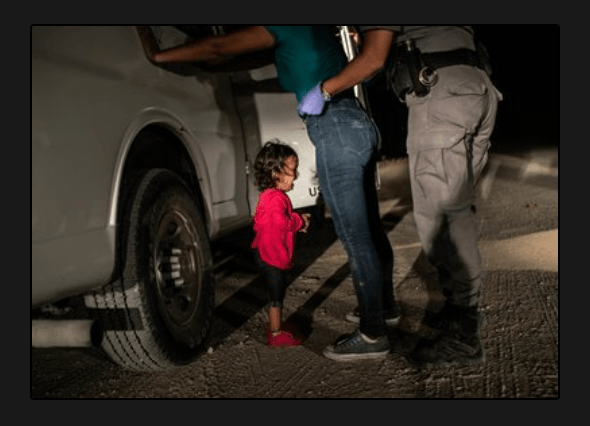
This photo, from the 2019 competition by John Moore shows a Honduran toddler crying as her father is being taken into custody at the US border. This picture is one of many which have portrayed the huge issue of the last few years surrounding the US-Mexican border and the illegal immigration of thousands. This issue of separating children from their parents has been one of the forefront issues in the media, as many human rights activists do not believe this should occur, but the United States government is very dead set on the fact that these illegal immigrants will be criminally prosecuted. According to NBC News, that number of separated families is now up to over 5,400.

NBC goes on to explain how inhumane this system is and how flawed it has become where children are not always recovered when the process is said and done. This picture takes the support of these innocent children, as the ideal victim theory is well at play here. The author John Moore is an author and photojournalist who is dedicated to the issue of family separation and highlighting the issues of the border patrol humanitarian crisis, as he recently published a book in March 2018 titled “Undocumented: Immigration and the Militarization of the United States-Mexico Border.” He aims to provide a humanitarian approach to the immigration process our country currently faces. This is firmly based as an international conflict, as many Southern American immigrants to the United States are directly affected by this process, with thousands of families attempting to enter the country being broken up. He likely would have been writing and taking these pictures for the younger audiences, so that their views may be shaped as they see the cruel reality of the world and the unspoken truth of our country and its immigration policies. I have noticed that many of the photos that were nominated in this year were of the same border issue, and from that it can be concluded how serious of an international issue this was. There were few photographs from other parts of the world, and multiple different photos capturing this same issue, really driving home to viewers the severity and cruciality of this border humanitarian crisis.
After seeing all of the photographs highlighting this issue, and especially this one, I am a firm believer that photojournalism can, in fact, change the world. With the young audience that is being targeted in this picture, authors are able to share injustice with the world in a way that words can not adequately capture. By seeing a young child being stripped away from her parents with your own eyes, it allows a global compassion and allows you to feel for those in the photographs. Pictures can accomplish so much more than words, even the best words will never stack up to a well taken picture. These pictures are able to spread awareness of an issue that people can make personal, it promotes change in hopes that we will never have to see another young child cry like that as she is pried away hopelessly from her parents.
Luckily, from these photos and other means, there has been positive social change that has come from this terrible situation. According to The Guardian, there have been upwards of 300 children adopted into the United States so far by ‘pro-life’ christian organizations who are looking to provide the hopeless children with the lives their parents set out on that journey to give them. It is great for the photojournalists to see this, as it goes to show that their work is not going unnoticed. All things considered, this is a great example to show that photojournalism really can change the world.
“Crying Girl on the Border.” John Moore POY | World Press Photo. Accessed March 19, 2020. https://www.worldpressphoto.org/collection/photo/2019/38262/1/John-Moore-(2).
Filipovic, Jill. “Adoption of Separated Migrant Kids Shows ‘pro-Life’ Groups’ Disrespect for Maternity | Jill Filipovic.” The Guardian. Guardian News and Media, October 30, 2019. https://www.theguardian.com/commentisfree/2019/oct/30/adoption-separated-migrant-children-pro-lifers-deep-disrespect-for-maternity.
Press, Associated. “More than 5,400 Children Split at Border, According to New Count.” NBCNews.com. NBCUniversal News Group, October 25, 2019. https://www.nbcnews.com/news/us-news/more-5-400-children-split-border-according-new-count-n1071791.
Countless hours, absorbed in the phone. Always going just for the picture. Always thinking about the next post. What are people going to think if I do this? What will this say about me, what will my followers think? These are all questions that can be examined in the episode Nosedive of Black Mirror. The episode shows a fantasized society where social media and social rankings run the world. Without certain rankings, people are limited to where they can go, things they can do, and even lines they must wait in. This social credit the episode refers to is constantly fluctuating in every single interaction. Based on what others around you think, your credit will rise or fall accordingly. There are rewards programs and benefits of being highly rated, and penalties and many restrictions for those with low scores. There is portrayed an upper class, all of whom are highly rated, and portrayed as highly materialistic, or fake. According to the buzzfeed news article from the recommended readings, the lifestyle can be very costly and very tiring on those who are trying to ‘make it.’ The buzzfeed article focuses in on a Mary Gui, who walks us through her routine and aims to make it big. It speaks of the hours she spends seeking the perfect pictures, the money she often spends on clothing and photographers, and the stress that goes into making this lifestyle worth it. Immediately, to me this seems very superficial and very stressful.
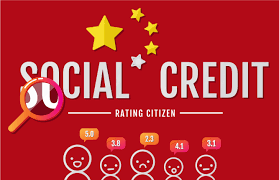
The stress I get from reading this article is mirrored at the end of the episode when Lacie finally snaps. After getting trapped in the airport, and having her dreams of a high social score snapped, she finally breaks and lets loose. This episode, while showing a social credit system society, is more focused on the critique of this scoring system, in my opinion. It portrays a ‘more than perfect’ society where everyone is nice and polite and proper all the time, but completely neglects the negative feelings in life. There are multiple times throughout the episode where characters are not able to express how they truly feel, or even have to ignore certain individuals who are not deemed ‘high enough’ scoring. One employee in Lacie’s company was punished for breaking up with his girlfriend, and his social score got so low that he was not even allowed in the place where he works.
While this system, in theory, seems like it could be a great way to hold citizens accountable, I am skeptical of its actual impact on society. According to businessinsider, China is implimenting this system in hopes to keep their citizens on their game. “The ‘social credit system,’ first announced in 2014, aims to reinforce the idea that keeping trust is glorious and breaking trust is disgraceful.” This sounds like a good idea in theory, but with the current social media landscape and the objectification and standards that are imposed on society without any sort of scoring system, I can only imagine the implications a scoring system would have on us. As seen in black mirror, a scoring system would place social media on the forefront of our lives more than it already has. For many, social media is a crucial cornerstone to their identity, however many people do not see it this way. If this social credit system went in place, I think the world would quickly have issues, especially those who do not use social media.

A lot of them would have high social scores without social media, however they would not be able to accurately convey their social aptitude in a society like this. I think that there is still much to consider before trying to implement a system like this, and I do not believe as though all of these things have been thought out yet to the level necessary.
I strongly believe that china is going to have major issues with implementing this system and relying on it solely do to the fact that social media is such a confounding factor for it, and as I mentioned above, many people are not very savvy with this technology. As shown in black mirror, it is not a very healthy system for the public to be relying on, and clearly it is very tough on mental health. People seem to get so locked in on their online presence that they tend to forget about the rest of their life, and life off the screen. It is in my opinion that this social scoring world should not occur any time in the near future, as it is very unhealthy for those living in the show Black Mirror.
Lee, Jarry. “What Does It Cost To Be Big On Instagram?” BuzzFeed News. BuzzFeed News, January 9, 2019. https://www.buzzfeednews.com/article/jarrylee/what-does-it-cost-to-be-big-on-instagram#.mqKevjlE5.
Ma, Alexandra. “China Has Started Ranking Citizens with a Creepy ‘Social Credit’ System – Here’s What You Can Do Wrong, and the Embarrassing, Demeaning Ways They Can Punish You.” Business Insider. Business Insider, October 29, 2018. https://www.businessinsider.com/china-social-credit-system-punishments-and-rewards-explained-2018-4.
Digital Identity has become an ever-important part of today’s society. It is used for almost everything. Introductions to new people, school applications, work applications and almost any new interaction with people. It has become filled with objectification, narcissism and envy-seeking vacation pictures. It has given rise to the selfie, the center of self-absorption. Selfies have been adapted greatly during the rise of modern social media, and are now a very commonly shared form of entertainment. According to Vulture, they have evolved into an instant, gratifying image that portrays the best of a person. They have become more casual, more free and more perfect. It is a phenomenon that has been picked up by all people, it is no longer just a trend the kids have picked up. Presidents, politicians, celebrities, grandparents and the like have all adopted the new idea of the selfie. It is an easy thing to do, and thanks to today’s phones and cameras, is so easy that it can be done with just the click of a button. The new technology landscape allows people to try again and again until they can get the picture right. They are able to show or tell. They can be used to show certain aspect of one’s body, or share a message. They are often posted to social media in order to share a certain message with their intended audience, and are always well planned. They have their own history, their own evolution and inevitably, their own future. The art of the selfie is an ever changing field, and they have come a long way since the time they first originated.

It is very interesting to analyze these selfies, as they really are a work of art. What seems to be just a simple picture is actually a well thought out, planned and executed work of art meant to communicate to an audience, no matter how small. Selfies have taken the world by storm, actually passing by the number of people killed by shark attacks. What originated as a safe and fun way to share in expression has actually gone so far as to kill people. As mentioned in an article written in The Wire, this has become true. They believe that the selfie has deviated from its original purpose of sharing content and user generated photographs, but has actually become a monster. One that has ruined vacations, travel, sacred moments and even taken lives. The author of this article believes that the selfie has turned from a fun memory or memento from a family trip to, now, an illusion that fun was had on a trip.

It is a very interesting point to be made, and something I have definitely seen change across the time that I have been alive and on vacations with my family. When I was younger, my mother would often take pictures of my brother and I in front of monuments or other places, but this was for the memories for our family. These pictures were not edited, filtered, tuned and posted for the world to see. In more recent years, however, the vacations I have gone on have allowed me to notice a shift in the picture-taking. I used to be embarrassed being one of the few children taking pictures in front of monuments, but nowadays it appears that nobody is really looking at the monuments and are now only taking pictures of them. Following the taking of the picture, people often spend a while editing, adjusting lighting or other parameters in order to make it the ‘perfect picture’ so that their following can be jealous of where they are. This has turned world exploration and vacations as a whole into a status operation rather than traveling to learn the cultures of the world.
Looking forward to how social media affects my life and how I interact with it, I would say that I often fall into the trap of the phenomenon that I have mentioned above. Whether it is myself, or my friends around me, I have noticed that, especially abroad, people often do things ‘just for the picture.’ Whether that is traveling to more touristy destinations, or skydiving in Interlaken, I have noticed that this generation of college kids will go do things just to get the shot to show their friends. Social media, especially those such as snapchat and instagram have been major causes for this change. They are skyrocketing in popularity among the college and high school students and even younger, and everyone wants to be deemed ‘cool.’ This has become part of the standard that makes someone cool on social media and is a major factor for students to study abroad or travel internationally. I would say that this has caused less sincerity and authenticity in the taking of pictures as the motivation for this has become impure.
Pilon, Mary. “Instagram Is Ruining Vacation.” Wired. Conde Nast, June 20, 2017. https://www.wired.com/2016/04/instagram-is-ruining-vacation/.
Uncredited/A2013. “Art at Arm’s Length: A History of the Selfie.” Vulture, January 26, 2014. https://www.vulture.com/2014/01/history-of-the-selfie.html.

 Auston Locke's Blog